
Dreams can feel random, emotional, strange, or surprisingly clear. If you are searching for dream insights meaning, you may be wondering whether a recent dream contains a deeper message about your emotions, relationships, fears, or daily life. In many cases, dream insights come from the mind processing experiences, memories, feelings, and concerns rather than predicting the future.
Dream interpretation is personal. The same dream symbol can mean something completely different to two people. A storm might represent fear for one person and freedom for another. The most useful way to understand a dream is to consider the symbol, your emotions during the dream, and what is happening in your waking life.
This guide explores the spiritual, biblical, psychological, and emotional sides of dream symbolism while showing you how to interpret your own dreams thoughtfully.
Quick Answer: Dream insights meaning generally refers to the personal understanding or emotional messages you may gain from your dreams. Dreams can reflect stress, memories, hopes, fears, relationships, unresolved emotions, or ordinary experiences from daily life. Their meaning is usually personal rather than universal.
What Does Dream Insights Meaning Mean?
Dream insights meaning refers to the possible understanding, self-awareness, or emotional information you gain by examining your dreams.
A dream does not always have a hidden message. Sometimes your brain may simply be combining memories, images, emotions, and recent experiences while you sleep.
However, certain dreams can feel meaningful because they connect strongly with something happening in your life.
For example, imagine you are preparing for an important job interview and dream that you arrive late. The dream may not predict that you will actually be late. Instead, it could reflect anxiety about being judged or fear of not being prepared.
A Simple Dream Interpretation Formula
When asking, “What does this dream mean?”, consider these four questions:
- What happened? — Identify the main events and symbols.
- How did you feel? — Fear, excitement, sadness, relief, anger, or peace can change the interpretation.
- What is happening in your life? — Look for current stressors, relationships, decisions, or changes.
- What stands out most? — The strongest or most unusual detail may offer the best starting point.
The important point is that dream symbolism should not be treated like a fixed dictionary.
Common Interpretations of Dream Insights Meaning
Dreams can provide different kinds of personal insight. Some common themes include:
| Dream theme | Possible insight |
| Being chased | Avoidance, pressure, fear, or unresolved conflict |
| Falling | Loss of control, insecurity, or major life changes |
| Flying | Freedom, confidence, ambition, or escape |
| Losing something | Fear of change, separation, or insecurity |
| Meeting someone from the past | Memories or unresolved feelings |
| Water | Emotional state, depending on whether it is calm or threatening |
| A house | Personal life, identity, memories, or different areas of yourself |
| Being unable to speak | Frustration, helplessness, or feeling unheard |
These are possibilities, not rules.
Your personal associations matter more than a generic dream dictionary. If dogs make you feel safe, dreaming about a dog may have a very different meaning from someone who is afraid of dogs.
Why Context Matters
Consider a person who dreams about an empty house.
For someone who recently moved away from family, the house might represent loneliness or nostalgia. For someone starting a new chapter, it might symbolize possibility and independence.
The image stays the same, but the emotional context changes the dream meaning.
Real-Life Reasons Behind This Dream
Many dreams are connected to ordinary waking-life experiences.
Your brain may process information from:
- Work or school pressure
- Family disagreements
- Romantic relationships
- Financial concerns
- Major decisions
- Moving or changing jobs
- Grief or memories
- Social interactions
- Fear about the future
- Exciting personal goals
Sometimes a tiny event can appear in a dream because it carries emotional weight.
For example, someone might receive a short text from a friend that seems harmless. If the person spends the rest of the day wondering whether something is wrong, that uncertainty could later appear in a dream.
The “Day Residue” Effect
Dreams can incorporate recent experiences, conversations, places, and thoughts. Something you noticed during the day may appear in a strange form while you sleep.
This is one reason dream interpretation should begin with your recent life rather than immediately assuming a supernatural explanation.
Emotions Behind the Dream
The emotion you experience may be more useful than the symbol itself.
A dream about an ocean could represent peace if you feel relaxed while floating on calm water. The same ocean could represent fear if enormous waves are pulling you underwater.
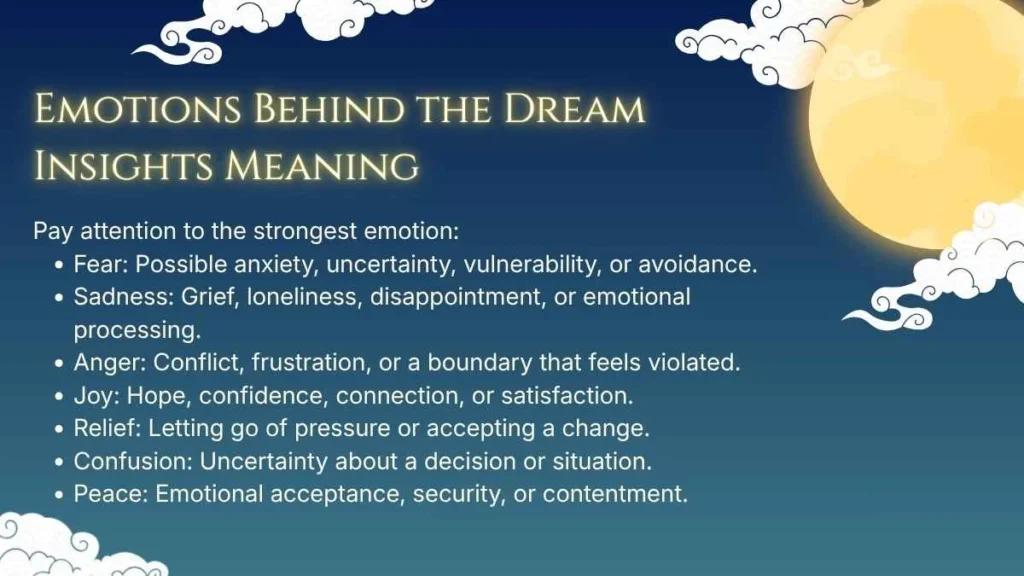
Pay attention to the strongest emotion:
- Fear: Possible anxiety, uncertainty, vulnerability, or avoidance.
- Sadness: Grief, loneliness, disappointment, or emotional processing.
- Anger: Conflict, frustration, or a boundary that feels violated.
- Joy: Hope, confidence, connection, or satisfaction.
- Relief: Letting go of pressure or accepting a change.
- Confusion: Uncertainty about a decision or situation.
- Peace: Emotional acceptance, security, or contentment.
A Useful Question
Instead of asking only, “What does this symbol mean?” ask:
“Where in my waking life have I felt this same emotion recently?”
That question can reveal more than a traditional dream dictionary.
Spiritual Meaning of Dream Insights Meaning
From a spiritual perspective, dreams are sometimes viewed as opportunities for reflection, guidance, prayer, or deeper self-awareness.
Different spiritual traditions interpret dreams differently. Some people believe certain dreams can carry spiritual significance, while others see dreams mainly as a natural part of human consciousness.
A spiritually meaningful dream may encourage you to examine:
- Your values
- Your relationships
- Your sense of purpose
- Your fears
- Your choices
- Your need for forgiveness
- Your desire for peace or direction
It is wise to avoid assuming that every unusual dream is a supernatural message.
A balanced approach is to reflect on the dream while considering your personal beliefs and real-life circumstances.
Biblical Meaning of Dream Insights Meaning
The Bible contains several important dreams and visions, including accounts involving Joseph, Daniel, Jacob, and others. Because of these stories, many Christians naturally wonder whether their own dreams have biblical significance.
Biblically, dreams can sometimes appear as a means through which God communicates in specific scriptural accounts. However, the Bible does not establish a universal dream dictionary where every symbol has one guaranteed meaning.
For example, biblical dream interpretation often depends on the surrounding story, God’s message, and the circumstances of the person involved.
If you are approaching a dream from a Christian perspective, consider:
- Pray for wisdom and discernment.
- Compare any perceived message with biblical teachings.
- Avoid making major decisions based only on a dream.
- Consider whether the dream reflects an existing fear or concern.
- Discuss confusing or significant experiences with a trusted spiritual leader when appropriate.
A powerful dream can inspire reflection, but it should not automatically be treated as a prophecy.
Psychological Meaning: A Science-Based Explanation
Modern psychology generally treats dreams as part of normal sleep and mental processing rather than as proven predictions of future events.
Research into dreaming has explored relationships between dreams, memory, emotions, learning, and waking experiences. The exact function of dreaming remains an active area of scientific study.
One useful psychological perspective is that dreams may sometimes reflect emotionally important experiences.
For example, if you spend the day worrying about an upcoming presentation, your dream might involve being on stage, forgetting your words, or arriving unprepared.
That does not necessarily mean the presentation will go badly. Your sleeping brain may simply be processing anxiety.
Dreams and Stress
Stress can influence dream content and emotional intensity. When your mind is overloaded, dreams may become more vivid, unpleasant, repetitive, or emotionally charged.
A recurring dream may therefore be worth examining alongside your current stress level.
If nightmares are frequent and interfere with sleep or daytime functioning, it can be helpful to speak with a qualified mental health professional.
Is This Dream Positive or Negative?
A dream is not automatically positive or negative because of its imagery.
A dream involving death, for example, does not necessarily mean literal death. It can symbolize endings, transitions, identity changes, or fear of losing something important.
Likewise, a beautiful dream does not guarantee that something good will happen.
| Dream experience | Possible positive side | Possible difficult side |
| Falling | Letting go | Feeling out of control |
| Death | Transformation | Fear of loss |
| Flying | Freedom | Escaping reality |
| Darkness | Rest and mystery | Fear or uncertainty |
| Water | Emotional renewal | Emotional overwhelm |
| Fire | Change and energy | Anger or destruction |
The emotion and life context help determine which interpretation makes the most sense.
When This Dream Is a Warning
A dream can be useful as a personal warning sign when it highlights emotions or problems you may be ignoring.
For example, repeatedly dreaming about being trapped might encourage you to examine whether you feel trapped at work, in a relationship, or in another part of your life.
The warning does not have to be supernatural.
Think of it as an invitation to pay attention.
Consider a Dream More Carefully If:
- The same distressing theme keeps returning.
- You wake up extremely anxious.
- The dream connects strongly with an ongoing conflict.
- You are avoiding an important decision.
- The dream reflects significant emotional distress.
- It is affecting your sleep or daily functioning.
The useful question is not, “Will this dream come true?” but rather, “What part of my life might this dream be drawing my attention toward?”
When You Should Ignore This Dream
Not every dream deserves detailed analysis.
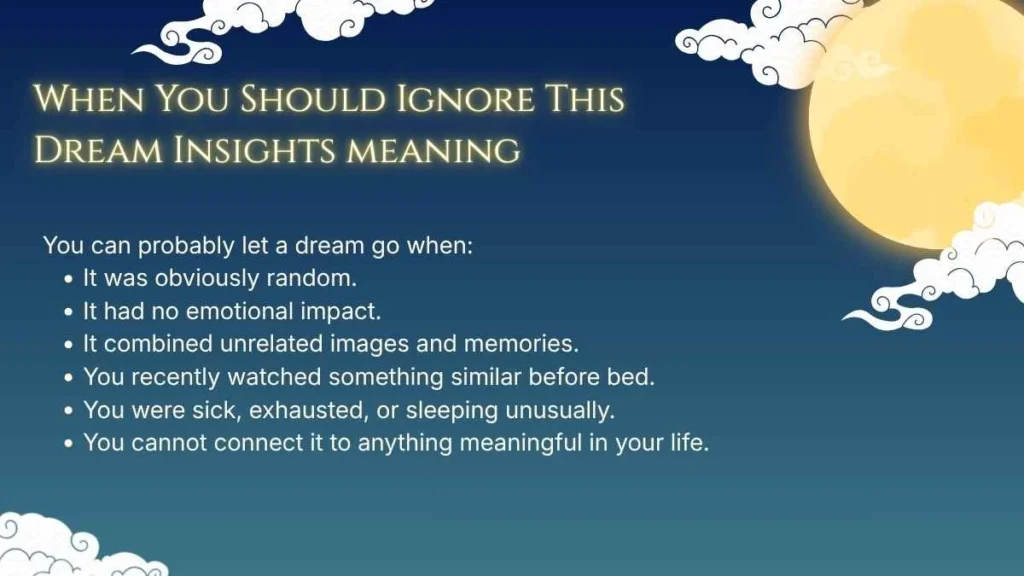
You can probably let a dream go when:
- It was obviously random.
- It had no emotional impact.
- It combined unrelated images and memories.
- You recently watched something similar before bed.
- You were sick, exhausted, or sleeping unusually.
- You cannot connect it to anything meaningful in your life.
Overanalyzing every dream can create unnecessary anxiety.
Dream interpretation should help you understand yourself, not make you afraid of ordinary sleep experiences.
Different Scenarios of This Dream
The details of a dream can dramatically change its possible meaning.
1. Dreaming That You Receive an Important Message
This may reflect a desire for clarity or answers. You might be waiting for someone to contact you or struggling with an uncertain decision.
2. Dreaming That You Cannot Understand a Message
This can symbolize confusion, mixed signals, or difficulty understanding your own feelings.
For example, if you are unsure about a relationship, a dream involving unreadable writing could represent emotional uncertainty.
3. Dreaming About Someone Giving You Advice
This may reflect your own inner thoughts. The person in the dream could represent qualities you associate with wisdom, safety, authority, or experience.
4. Dreaming About a Repeated Symbol
Recurring symbols deserve attention because repetition may indicate an unresolved emotional theme.
Write down what changes between each version of the dream. Those differences can be more informative than the repeated symbol itself.
5. Having a Peaceful, Insightful Dream
A calm dream may reflect emotional processing, hope, acceptance, or a growing sense of clarity.
It may be useful to record the insight immediately after waking before the details disappear.
6. Having a Frightening or Confusing Dream
A frightening dream may reflect stress, fear, recent experiences, or unresolved emotions. It does not automatically predict a negative event.
What Should You Do After Seeing This Dream?
Instead of searching dozens of dream dictionaries, use this simple process.
Step 1: Write It Down
Record the dream as soon as you wake up. Include people, places, objects, events, and emotions.
Step 2: Identify the Strongest Feeling
Was the dream mainly about fear, excitement, grief, anger, confusion, or relief?
Step 3: Connect It to Real Life
Ask yourself:
“What happened recently that made me feel this way?”
Step 4: Separate Symbol From Prediction
Treat the dream as a possible reflection, not a guaranteed forecast.
Step 5: Look for a Useful Action
If the dream reveals stress, perhaps you need rest. If it highlights conflict, perhaps you need an honest conversation. If it reflects uncertainty, you might need more information before making a decision.
Quick Decision Guide
Did the dream strongly affect you?
↓ Yes
Does it connect to a current emotion or life situation?
↓ Yes
→ Journal about the connection and consider what practical change could help.
No
→ Treat it as a normal dream and move on.
Is it repeatedly disturbing your sleep?
↓ Yes
→ Consider discussing the problem with a qualified healthcare or mental health professional.
FAQs About Dream Insights Meaning
1. What does dream insights meaning really mean?
Dream insights meaning refers to the possible self-understanding you gain by examining your dreams, emotions, memories, and waking-life experiences. It is usually personal rather than universal.
2. Can dreams predict the future?
There is no reliable scientific basis for treating ordinary dreams as guaranteed predictions of future events. Some religious traditions assign spiritual significance to particular dreams, but personal dreams should be interpreted carefully.
3. Why do I dream about the same thing repeatedly?
Recurring dreams may be associated with unresolved emotions, stress, memories, fears, or repeated situations in waking life. The specific cause differs from person to person.
4. Does every dream have a hidden meaning?
No. Some dreams may simply reflect normal brain activity, recent experiences, memories, or random combinations of information. Not every dream needs interpretation.
5. How can I understand what my dream means?
Start by writing down the dream, identifying its strongest emotion, and connecting that emotion with recent events in your life. Your personal associations are often more useful than a generic dream-symbol dictionary.
References
For reliable background on sleep, dreaming, psychology, and biblical interpretation, readers can consult authoritative resources such as:
- American Psychological Association — information on psychology, emotions, stress, and mental health.
- National Institute of Neurological Disorders and Stroke — educational information about sleep and the brain.
- National Sleep Foundation — resources covering sleep health and dreaming.
- Bible passages concerning dreams and visions, including Genesis 37, Genesis 40–41, Daniel 2, and Matthew 1–2.
These sources provide useful context, but no single reference can determine the personal meaning of an individual dream.
Conclusion
The most helpful dream insights meaning is rarely found by assigning one fixed definition to a symbol. Your dream becomes more understandable when you look at the complete picture: what happened, how you felt, what you have experienced recently, and what concerns are currently occupying your mind.
A strange dream may simply be your brain processing the day. A recurring dream may point toward an emotional issue worth exploring. A spiritual dream may hold personal significance within your faith. None of these possibilities means you should automatically treat a dream as a prediction.
Tonight, if you have a vivid dream, write it down before checking your phone. Notice the strongest emotion, connect it with your waking life, and ask what useful insight you can take from it. That simple habit can turn dream interpretation from guesswork into meaningful self-reflection.

Andrew Parker is a passionate writer and creative storyteller known for his engaging writing style and deep understanding of modern literature, self-growth, and digital culture. With years of experience in content creation and research, Andrew has built a strong reputation for delivering insightful, inspiring, and reader-friendly content.
He is the author of several popular books, including The Power of Positive Thinking in Modern Life, Digital Dreams, Beyond the Limits, and Mindset for Success. His work focuses on motivation, personal development, innovation, and helping readers discover practical ways to improve their lives.
At Dreaming Hub, Andrew shares valuable articles, thoughtful ideas, and inspiring perspectives designed to educate, motivate, and connect with readers around the world. His writing combines creativity with real-world experience, making his content both informative and enjoyable to read.