

Dreams about cheating can feel surprisingly real, especially when you wake up angry, guilty, confused, or afraid. Cheating dreams do not automatically mean that you or your partner actually want to cheat. More often, the dream may reflect insecurity, fear of losing someone, relationship stress, guilt, unmet emotional needs, or experiences from your daily life.
Dream interpretation is personal because the same dream can mean different things to different people. A cheating dream may be connected to trust, attention, jealousy, self-worth, change, or even something unrelated to romance. Modern research also suggests that dreaming can be connected with emotional processing and memories from waking life.
So, what does this dream mean? The most useful approach is to look at who cheated, how you felt, what happened in the dream, and what was happening in your real life.
What Does Cheating Dreams Mean?
Cheating dreams usually symbolize an emotional concern rather than a literal desire to be unfaithful.
For example, if you dream that your partner cheats on you, the dream may represent fear of rejection, abandonment, comparison, or losing emotional security. It does not prove that your partner is cheating.
If you dream that you cheat on your partner, you might wake up feeling guilty. However, the dream does not necessarily reveal a hidden wish. It can symbolize curiosity, emotional distance, a need for attention, dissatisfaction with another part of life, or anxiety about doing something wrong.
The key is to examine the emotion behind the dream rather than focusing only on the cheating scene.
Quick answer
Cheating dreams often reflect trust issues, insecurity, relationship fears, guilt, emotional stress, or unresolved experiences. They are not reliable evidence that someone is actually cheating.
Common Interpretations of Cheating Dreams
There are several common meanings behind this type of dream.
1. Fear of losing someone
If someone important to you has recently become distant, your subconscious may turn that fear into a dramatic dream.
The cheating may symbolize the possibility of losing their attention or affection.
2. Insecurity or comparison
You may be comparing yourself with another person, especially if you feel that someone else is more attractive, successful, confident, or interesting.
The dream can act like a mirror for those feelings.
3. Lack of attention
Sometimes the real issue is not infidelity but emotional neglect.
If you feel ignored, unheard, or disconnected from your partner, your mind may create a cheating scenario to express the emotional distance.
4. Guilt
A cheating dream can appear when you feel guilty about something completely unrelated to relationships.
For example, you may feel guilty about lying to a friend, missing an important responsibility, or hiding a personal decision.
5. Fear after past betrayal
If you have experienced infidelity before, your brain may remain sensitive to similar situations.
A current relationship may be healthy while an old emotional wound still affects your dreams.
Real-Life Reasons Behind This Dream
Dreams often contain material connected to waking experiences. Research on dreaming suggests that emotional experiences and memories can appear in dreams, although scientists still do not have one complete explanation for why particular dream stories occur.
Common real-life triggers include:
- Arguments with your partner
- A recent breakup
- Trust problems
- Watching a movie involving infidelity
- Seeing relationship drama on social media
- Feeling emotionally neglected
- Meeting an attractive new person
- Fear of commitment
- Past relationship trauma
- Major life changes
- Work or financial stress
- Poor sleep or increased anxiety
For example, imagine that your partner has been working late for several weeks. You know there is a reasonable explanation, but you still feel lonely. That emotional combination may appear in a dream as your partner being unfaithful.
The dream may therefore be saying, “I feel disconnected,” rather than “My partner is cheating.”
Emotions Behind the Dream
Your emotion during and after the dream can provide an important clue.
| Emotion | Possible meaning |
| Jealousy | Fear of comparison or losing someone |
| Anger | Feeling disrespected or ignored |
| Guilt | Fear that you have done something wrong |
| Sadness | Emotional distance or fear of loss |
| Anxiety | Uncertainty or lack of control |
| Relief | Desire for change or emotional freedom |
| Confusion | Unresolved feelings or mixed priorities |
Pay attention to the strongest emotion.
If the dream itself is forgotten but the anxiety remains for hours, that anxiety may be more meaningful than the specific details of the dream.
Spiritual Meaning of Cheating Dreams
From a spiritual perspective, some people view cheating dreams as messages about trust, loyalty, emotional balance, or personal growth.
A spiritual interpretation might suggest that the dream is encouraging you to examine:
- Whether you trust yourself
- Whether you trust another person
- Whether you are ignoring an emotional problem
- Whether you need stronger personal boundaries
- Whether you are afraid of change
- Whether an old emotional wound needs attention
However, spiritual dream interpretation should not be treated as a guaranteed prediction.
A dream about cheating does not automatically mean that a partner is unfaithful, that a relationship will end, or that a supernatural event is about to happen.
A healthier spiritual approach is to use the dream as an invitation for self-reflection, prayer, honesty, and emotional awareness.
Biblical Meaning of Cheating Dreams
The Bible contains several important dreams and visions, including dreams experienced by Joseph and Daniel. Scripture also presents dreams as something that can sometimes have spiritual significance. For example, Joel 2:28 speaks about people dreaming dreams, while Daniel 4 describes a troubling dream that deeply affected King Nebuchadnezzar.
At the same time, the Bible does not provide a universal rule saying that dreaming about cheating means your spouse is actually cheating.
From a biblical perspective, the more useful themes may be faithfulness, honesty, temptation, trust, forgiveness, and the condition of the heart.
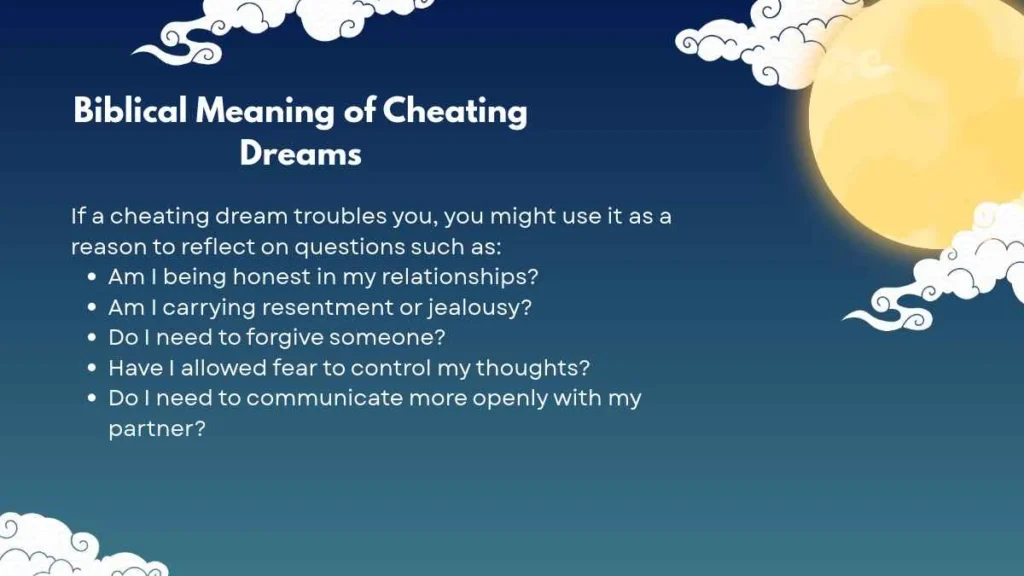
If a cheating dream troubles you, you might use it as a reason to reflect on questions such as:
- Am I being honest in my relationships?
- Am I carrying resentment or jealousy?
- Do I need to forgive someone?
- Have I allowed fear to control my thoughts?
- Do I need to communicate more openly with my partner?
For Christians, prayer and Scripture can provide a framework for reflection. But it is important not to accuse another person of wrongdoing based only on a dream.
Psychological Meaning: What Science Says
Modern psychology does not support a single dictionary where every dream symbol has one fixed meaning.
Instead, researchers have explored connections between dreams, emotions, memories, stress, and sleep. Reviews suggest that dreaming—particularly during REM sleep—can be associated with emotional memory processing and the reprocessing of waking experiences.
One research perspective is the continuity hypothesis, which proposes that dream experiences can reflect concerns and emotions from waking life. Other theories suggest that dreaming may help simulate situations or process emotional material. These explanations are still being studied rather than proven as one universal theory.
This is why a cheating dream can feel emotionally intense without being a literal message.
For example, if you spend the day worrying that your partner is losing interest, your sleeping brain may combine that concern with memories, people, places, and emotions to create an entirely new dream scenario.
The dream is real as an emotional experience, but that does not make its storyline factual.
Is This Dream Positive or Negative?
It can be either.
Potentially negative meaning
The dream may point toward:
- Relationship anxiety
- Jealousy
- Fear of abandonment
- Low self-esteem
- Unresolved betrayal
- Emotional disconnection
- Excessive worry
Potentially positive meaning
The same dream could encourage:
- Better communication
- Emotional healing
- Greater self-awareness
- Stronger boundaries
- Honest conversations
- Letting go of old fears
A disturbing dream can sometimes reveal a problem that deserves attention. That does not mean the dream itself is bad.
When This Dream Is a Warning
A cheating dream may deserve closer attention when it repeatedly occurs alongside strong real-life concerns.
For example, consider taking a step back if:
- You constantly feel unsafe or mistrustful in your relationship.
- You are experiencing repeated conflict.
- You have unresolved pain from previous betrayal.
- You are avoiding an important conversation.
- The dream is causing significant daytime anxiety.
- Similar nightmares are repeatedly disrupting your sleep.
The “warning” does not have to be “someone is cheating.”
It may simply be “something about your emotional life needs attention.”
That distinction can prevent unnecessary accusations and conflict.
When You Should Ignore This
Sometimes a dream is simply a dream.
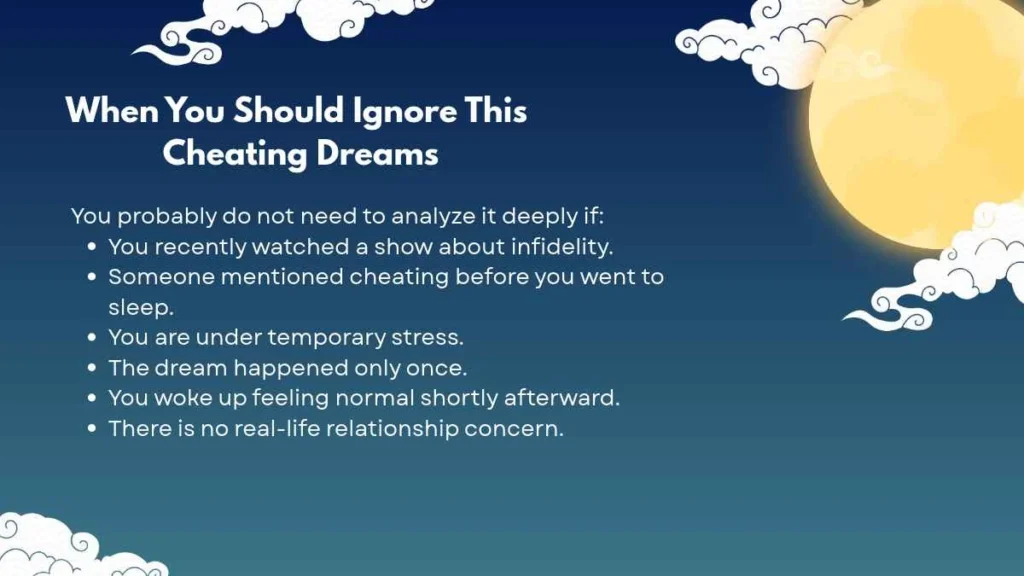
You probably do not need to analyze it deeply if:
- You recently watched a show about infidelity.
- Someone mentioned cheating before you went to sleep.
- You are under temporary stress.
- The dream happened only once.
- You woke up feeling normal shortly afterward.
- There is no real-life relationship concern.
Dreams can combine recent experiences in strange ways. Scientific research does not justify treating every dream as a hidden prediction.
Different Scenarios of Cheating Dreams
The details can change the possible interpretation.
1. Dreaming that your partner cheats on you
This often points toward insecurity, fear of abandonment, jealousy, or concerns about emotional distance.
It does not prove infidelity.
2. Dreaming that you cheat on your partner
This may reflect guilt, curiosity, emotional dissatisfaction, or fear of violating your own values.
Sometimes the “other person” represents a quality you want in your life rather than a person you actually desire.
3. Dreaming about cheating with a friend
This does not necessarily mean romantic attraction.
The friend may represent qualities you admire, such as confidence, freedom, humor, success, or emotional support.
4. Dreaming about an ex cheating with someone else
This can reflect unresolved feelings, comparison, old insecurity, or memories from that period of your life.
It does not necessarily mean you want your ex back.
5. Dreaming about your spouse cheating repeatedly
Repeated dreams may suggest that an emotional concern is not being resolved.
Ask yourself what happens in your relationship when you are awake. Is there mistrust, distance, or fear?
6. Dreaming about cheating and feeling no guilt
This can be especially confusing.
Rather than assuming it means you secretly want an affair, consider whether the dream represents independence, a desire for change, excitement, or freedom from a situation that feels restrictive.
A Simple Decision Guide
Did you dream about cheating?
↓
Do you have real-life evidence of relationship problems?
→ Yes: Talk calmly about the actual issue rather than using the dream as evidence.
→ No: Treat the dream as possible emotional processing, not proof.
↓
Is the dream recurring or causing distress?
→ Yes: Journal about the emotions and consider talking with a qualified mental-health professional if it continues to interfere with your sleep or daily life.
→ No: You can acknowledge it and move on.
What Should You Do After Seeing This Dream?
Do not immediately confront your partner.
Instead, try these steps:
- Write down the dream. Record the people, setting, events, and strongest emotion.
- Identify the feeling. Ask whether you felt fear, jealousy, guilt, anger, or sadness.
- Look at your recent life. Think about arguments, stress, changes, or relationship concerns.
- Separate dreams from evidence. A dream is not proof of someone’s behavior.
- Communicate if necessary. If you genuinely feel disconnected, discuss the relationship calmly.
- Look for patterns. One strange dream is very different from repeated distressing dreams.
- Protect your sleep. Ongoing nightmares or sleep disruption deserve attention.
If dreams repeatedly cause severe distress, interfere with sleep, or occur alongside trauma-related symptoms, professional support may be useful. Research into nightmares and emotional processing continues to explore how dream experiences relate to mental health and emotional regulation.
FAQs About Cheating Dreams
1. Does dreaming about cheating mean my partner is cheating?
No. A cheating dream cannot establish that your partner is unfaithful. It may reflect insecurity, fear, stress, past experiences, or emotional distance.
2. Why do I keep dreaming about cheating?
Repeated dreams may occur when an emotional concern remains unresolved. Relationship anxiety, past betrayal, stress, or fear of losing someone can influence recurring dream themes.
3. What does it mean when I dream that I cheat?
It can represent guilt, curiosity, emotional dissatisfaction, a desire for independence, or simply the brain combining unrelated memories and emotions. It does not automatically mean you want to cheat.
4. Is dreaming about cheating a bad sign?
Not necessarily. The dream may be uncomfortable, but it can help you notice emotions that you have overlooked. The important question is what the dream may be reflecting in your waking life.
5. What is the spiritual meaning of dreaming about infidelity?
Spiritually, some people interpret it as a reminder to examine trust, loyalty, honesty, boundaries, and emotional relationships. Different religious traditions interpret dreams differently, so there is no single universal spiritual meaning.
Conclusion
Cheating dreams are usually more useful as clues about emotions than predictions about the future. They can reflect insecurity, fear, jealousy, guilt, relationship stress, old wounds, or everyday experiences that your sleeping mind is processing.
The most important part of dream interpretation is not simply asking, “Who cheated?” Instead, ask, “What did I feel, and does that feeling connect to something happening in my life?”
If the dream exposes a genuine relationship concern, use it as an opportunity for honest communication. If there is no real-life problem, you may simply be experiencing your brain’s complex way of processing memories and emotions during sleep.
Do not let one frightening dream create suspicion without evidence. Use it for self-reflection, take care of your emotional well-being, and focus on what is actually happening in your waking life.
References
- Siclari, F. et al. Research on dreaming, emotional processing, and sleep: PubMed – The Functional Role of Dreaming in Emotional Processes
- Research review on sleep, dreaming, emotions, and memory: PMC – Sleep and dreaming are for important matters
- Research on dreaming and emotional memory processing: PMC – Evidence of an active role of dreaming in emotional memory processing
- Biblical passages concerning dreams: Bible Gateway – Genesis, Daniel, and Joel passages

Andrew Parker is a passionate writer and creative storyteller known for his engaging writing style and deep understanding of modern literature, self-growth, and digital culture. With years of experience in content creation and research, Andrew has built a strong reputation for delivering insightful, inspiring, and reader-friendly content.
He is the author of several popular books, including The Power of Positive Thinking in Modern Life, Digital Dreams, Beyond the Limits, and Mindset for Success. His work focuses on motivation, personal development, innovation, and helping readers discover practical ways to improve their lives.
At Dreaming Hub, Andrew shares valuable articles, thoughtful ideas, and inspiring perspectives designed to educate, motivate, and connect with readers around the world. His writing combines creativity with real-world experience, making his content both informative and enjoyable to read.