Dreams about alcohol can feel confusing, especially when you rarely drink or when the dream involves getting drunk, buying alcohol, refusing a drink, or watching someone else drink. Alcohol dreams interpreted through symbolism often point to themes such as control, temptation, escape, social pressure, emotional release, or a desire to relax. However, there is no single meaning that applies to everyone.
The most useful dream interpretation looks at the type of alcohol, what happened in the dream, your emotions, and what is happening in your waking life. Your personal experience matters more than a fixed dream dictionary definition.
Quick Answer: Alcohol in a dream may symbolize escape, loss of control, temptation, celebration, stress, emotional suppression, or social influence. If alcohol has recently appeared in your life, the dream may simply reflect recent memories or concerns rather than a deeper message.
What Does Alcohol Dreams Interpreted Mean?
When alcohol appears in a dream, it often represents something connected with control, pleasure, avoidance, or emotional freedom.
For example, drinking alcohol happily at a party may have a very different meaning from secretly drinking alone while feeling guilty. The object is the same, but the emotional context changes the interpretation.
Common symbolic meanings include:
- Escape: You may want a break from responsibilities or emotional pressure.
- Loss of control: Getting extremely drunk may represent fear that something in your life is becoming difficult to manage.
- Temptation: Alcohol may symbolize something attractive that you know could create problems.
- Relaxation: A drink may represent your desire to slow down and enjoy yourself.
- Social pressure: Drinking with friends can reflect concerns about fitting in or being accepted.
- Emotional release: The dream may represent feelings you normally keep hidden.
- Self-control: Refusing alcohol can symbolize boundaries, discipline, or resisting pressure.
The important question is not simply, “What does alcohol mean in dreams?” Ask instead: “What does alcohol represent to me right now?”
Common Interpretations of Alcohol Dreams
Different dream situations can create very different meanings.
Dreaming About Drinking Alcohol
Drinking may symbolize a desire for pleasure, freedom, or temporary relief from stress. If you felt happy, the dream might reflect your need for enjoyment or social connection.
If you felt ashamed, frightened, or out of control, the dream may reflect concerns about a choice or habit in your waking life.
Dreaming About Getting Drunk
Getting drunk in a dream can represent loss of control or emotional overload. You may feel that a situation, relationship, responsibility, or strong emotion is becoming difficult to manage.
It does not automatically mean you have a drinking problem.
Dreaming About Refusing Alcohol
Refusing a drink may symbolize strong boundaries. You could be trying to say no to something that conflicts with your values.
This can also represent growing confidence in making your own decisions rather than following other people’s expectations.
Dreaming About Someone Else Drinking
If another person is drinking heavily, consider your relationship with that person.
The dream could reflect:
- Concern about their behavior
- A past memory involving them
- Fear of losing their trust
- Social experiences you associate with them
- Your own feelings about alcohol projected onto the dream character
Dreaming About Buying Alcohol
Buying alcohol may symbolize preparation for pleasure, escape, or a decision you have not yet acted on.
The surrounding details matter. Buying a bottle for a celebration has a different emotional tone from secretly buying alcohol because you feel overwhelmed.
Real-Life Reasons Behind This Dream
Sometimes the simplest explanation is the most useful one.
Your brain may incorporate recent experiences, conversations, images, memories, or worries into dreams. Dream content does not always contain a hidden spiritual message.
You might dream about alcohol after:
- Attending a party
- Watching a movie where people drink
- Talking about someone’s drinking
- Feeling stressed at work
- Experiencing relationship conflict
- Thinking about an old memory
- Trying to change a habit
- Feeling pressure from friends
- Celebrating an important event
- Seeing alcohol before going to bed
Alcohol itself can also affect sleep. The National Institute on Alcohol Abuse and Alcoholism reports that alcohol can disrupt sleep, including changes in REM sleep, and can lead to fragmented sleep and earlier waking.
So if you drank before bed, a vivid or unusual dream may be connected with changes in your sleep rather than a symbolic warning.
Emotions Behind the Dream
Your emotion may be more important than the alcohol itself.
Ask yourself how you felt when you woke up.
| Dream emotion | Possible interpretation |
|---|---|
| Happiness | Desire for enjoyment or freedom |
| Fear | Loss of control or uncertainty |
| Guilt | Conflict with personal values |
| Embarrassment | Fear of judgment |
| Relief | Desire to escape pressure |
| Anger | Suppressed frustration |
| Loneliness | Need for connection |
| Confusion | Unresolved emotional conflict |
For example, imagine someone dreams about drinking alone after a stressful workday. The dream may have less to do with alcohol and more to do with wanting relief from pressure.
This is why dream interpretation should begin with the emotional experience rather than a fixed symbol.
Spiritual Meaning of Alcohol Dreams Interpreted
From a spiritual perspective, alcohol can symbolize temptation, excess, distraction, self-control, or the search for comfort.
Some people interpret drinking in dreams as a reminder to examine whether something is controlling too much of their attention. Others see it as a symbol of emotional release or the desire to escape everyday pressure.
A useful spiritual question is:
“Is there anything in my life that I use to avoid facing what I really feel?”
That does not have to be alcohol. It could be entertainment, social media, work, relationships, shopping, or another form of distraction.
A positive interpretation can involve recognizing the need for balance. A negative interpretation may involve feeling controlled by a habit, temptation, or unhealthy pattern.
There is no scientifically established spiritual dictionary that assigns one universal meaning to every alcohol dream. Spiritual dream interpretation is best treated as a reflective practice rather than a prediction of the future.
Biblical Meaning of Alcohol Dreams Interpreted
For Christians, alcohol dreams may bring biblical themes such as sobriety, wisdom, self-control, temptation, and spiritual priorities to mind.
The Bible discusses drunkenness and the misuse of alcohol in several passages. For example, Proverbs 20:1 warns about being led astray by wine and strong drink, while Ephesians 5:18 contrasts drunkenness with being filled with the Spirit.
Galatians 5 also places drunkenness among behaviors contrasted with the “fruit of the Spirit,” including self-control.
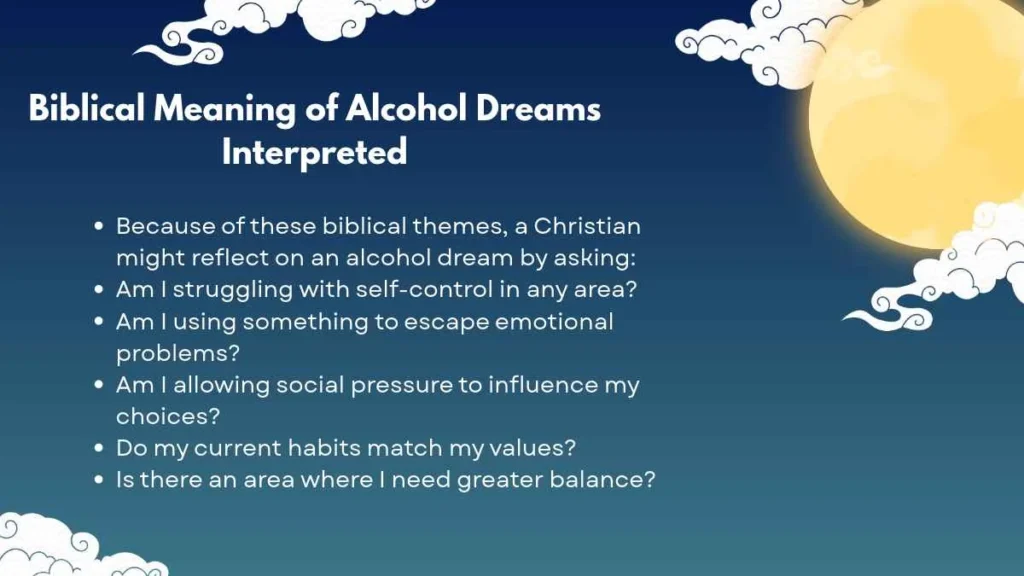
Because of these biblical themes, a Christian might reflect on an alcohol dream by asking:
- Am I struggling with self-control in any area?
- Am I using something to escape emotional problems?
- Am I allowing social pressure to influence my choices?
- Do my current habits match my values?
- Is there an area where I need greater balance?
Importantly, the Bible does not provide a universal rule saying that dreaming about alcohol means a specific future event will happen. A dream should not automatically be treated as a prophecy or divine warning.
Psychological Meaning of Alcohol Dreams
Modern psychology does not support the idea that every dream symbol has one fixed meaning.
Research suggests that sleep is connected with emotional processing and memory, although researchers continue to debate exactly how dreaming contributes to these processes. Reviews have found links between sleep, emotional memory, and emotional regulation, while also noting important limitations and unanswered questions.
This gives us a more practical way to understand alcohol dreams.
Your sleeping brain may combine:
- Recent experiences
- Emotional memories
- Personal concerns
- Social experiences
- Expectations
- Stress
- Familiar images and situations
For example, if you recently felt pressured by friends to do something you did not want to do, your brain might create a dream involving alcohol because drinking represents that social pressure in your personal experience.
Dreaming about alcohol therefore does not prove addiction, hidden desire, or a psychological disorder.
What If Alcohol Appears Repeatedly?
Repeated dreams deserve attention when they are emotionally intense or connected with a real-life problem.
If you repeatedly dream about drinking after trying to stop drinking, for example, the dream may be worth discussing with a qualified professional. The dream itself is not a diagnosis.
Likewise, recurring nightmares following trauma or severe stress can be worth discussing with a mental-health professional.
Is This Dream Positive or Negative?
An alcohol dream can have either positive or negative symbolism depending on the circumstances.
| Positive possibilities | Negative possibilities |
|---|---|
| Desire for relaxation | Loss of control |
| Celebration | Excess |
| Social connection | Peer pressure |
| Emotional release | Avoidance |
| Freedom | Temptation |
| Setting boundaries | Guilt or shame |
For instance, dreaming about calmly refusing a drink could represent confidence and healthy boundaries.
Dreaming about being unable to stop drinking while feeling terrified may instead reflect anxiety about losing control.
The dream is not automatically “good” or “bad.” The context determines the most reasonable interpretation.
When This Dream Is a Warning
An alcohol dream may be worth paying attention to when it connects strongly with something happening in your waking life.
Consider it a prompt for self-reflection if:
- You are worried about your drinking habits.
- You frequently drink to cope with stress.
- You recently experienced consequences from drinking.
- You feel pressured to drink socially.
- You are trying to quit or reduce alcohol use.
- The dream repeatedly involves guilt, fear, or loss of control.
- Someone close to you is experiencing alcohol-related problems.
NIAAA notes that signs of alcohol use disorder can include drinking more or longer than intended and repeatedly wanting to cut down but being unable to do so.
A dream cannot diagnose alcohol use disorder. However, if the dream reminds you of real-life concerns, those concerns deserve attention independently of the dream.
When You Should Ignore This Dream
Not every unusual dream needs deep interpretation.
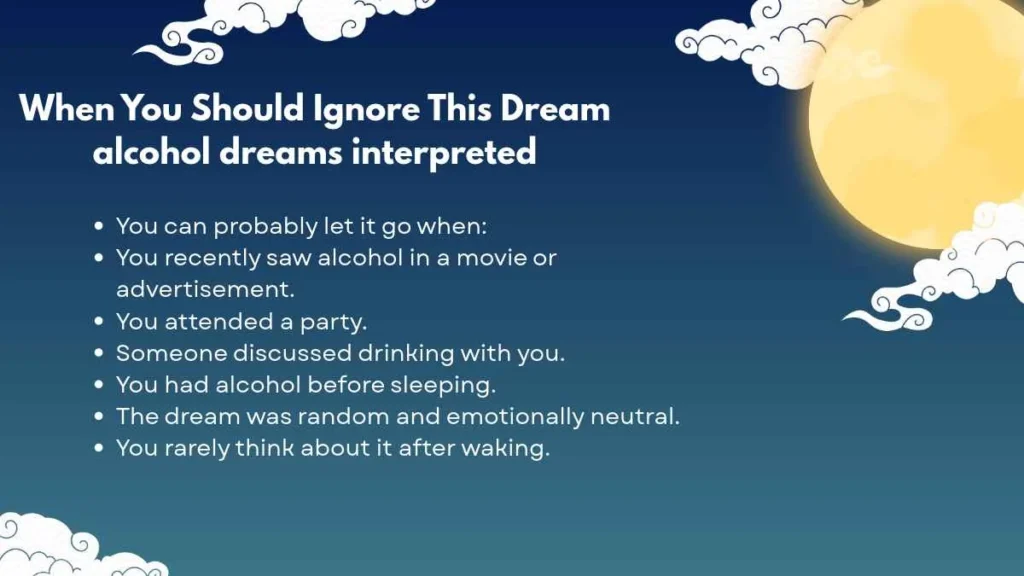
You can probably let it go when:
- You recently saw alcohol in a movie or advertisement.
- You attended a party.
- Someone discussed drinking with you.
- You had alcohol before sleeping.
- The dream was random and emotionally neutral.
- You rarely think about it after waking.
Trying to decode every dream can create unnecessary anxiety.
A helpful rule is:
If the dream has no meaningful connection to your waking life, you do not have to force a meaning onto it.
Different Scenarios of Alcohol Dreams
1. Dreaming of Drinking Alone
This may symbolize isolation, emotional pressure, or a desire to escape from responsibilities. If you felt peaceful, it may instead represent your need for private time.
2. Dreaming of Getting Drunk at a Party
This can reflect social pressure, the desire to fit in, or fear of embarrassing yourself in front of others.
3. Dreaming of Refusing a Drink
This often fits themes of boundaries, discipline, independence, or resisting temptation.
4. Dreaming of Someone Offering You Alcohol
The person offering the drink may matter. They could represent influence, pressure, temptation, friendship, or a memory from your past.
5. Dreaming That You Cannot Find Alcohol
This may symbolize frustration, unmet emotional needs, or the feeling that something you normally use for comfort is unavailable.
6. Dreaming About Alcohol After Quitting
This can occur when a major habit or past experience remains emotionally important. It does not necessarily mean you should return to drinking.
A Simple Decision Guide for Interpreting the Dream
Use this quick framework instead of relying on a generic dream dictionary:
Did alcohol appear recently in your real life?
→ Yes: Start with recent memories or experiences.
→ No: Ask what alcohol personally represents to you.
Did you feel relaxed?
→ Consider freedom, celebration, or a need for rest.
Did you feel afraid or out of control?
→ Consider stress, uncertainty, or concerns about control.
Did you feel guilty?
→ Consider a conflict between your actions, desires, and values.
Did the dream repeat?
→ Look for an ongoing emotional issue rather than assuming it predicts something.
What Should You Do After Seeing This Dream?
You do not need to make a major decision because of one dream.
Instead, try these simple steps:
- Write down the dream. Record the people, location, alcohol, actions, and emotions.
- Identify the strongest emotion. Fear, relief, guilt, excitement, or loneliness can provide useful clues.
- Look at the previous few days. Ask whether anything reminded you of alcohol.
- Check your stress level. Work, relationships, money, or family problems can influence dream content.
- Consider your personal values. Ask whether the dream connects with a choice or habit you are currently thinking about.
- Do not treat the dream as a prediction. Use it for reflection rather than fear.
- Seek help if the waking-life issue is serious. If alcohol use, trauma, anxiety, or recurring nightmares are affecting your life, speak with an appropriate healthcare or mental-health professional.
Key Takeaways
- Alcohol dreams do not have one universal meaning.
- The emotional context is often more informative than the alcohol itself.
- Drinking may symbolize escape, pleasure, temptation, social pressure, or loss of control.
- Refusing alcohol can symbolize boundaries and self-control.
- Recent experiences can influence dream content.
- Psychology connects dreaming and sleep with emotional and memory processes, but science does not support a fixed dream-symbol dictionary.
- Biblical interpretation may focus on themes such as sobriety, wisdom, and self-control rather than predicting future events.
- A dream alone cannot diagnose an alcohol problem.
- Recurring dreams may be useful prompts for examining real-life stress or emotions.
FAQs About Alcohol Dreams Interpreted
What does it mean when you dream about drinking alcohol?
It can symbolize relaxation, escape, pleasure, social pressure, temptation, or concerns about control. The meaning depends on your emotions and the situation in the dream.
What does it mean to dream about getting drunk?
Dreaming about getting drunk may represent feeling overwhelmed or afraid of losing control. It can also reflect recent experiences involving alcohol or social situations.
What is the spiritual meaning of drinking alcohol in a dream?
Spiritually, some people interpret alcohol as a symbol of temptation, distraction, excess, or the desire to escape. The most useful interpretation depends on your personal beliefs and circumstances.
What does alcohol represent in the Bible?
Biblical passages commonly connect excessive drinking and drunkenness with poor judgment and a lack of self-control. Proverbs 20:1 and Ephesians 5:18 are frequently referenced when discussing these themes.
Does dreaming about alcohol mean I have a drinking problem?
No. A dream by itself cannot diagnose alcohol use disorder. If you are also experiencing real-life signs such as repeatedly drinking more than intended or being unable to cut down despite wanting to, those waking-life behaviors are much more important to address.
Editorial Note
Dream interpretation is not an exact science. Symbolic, spiritual, and biblical interpretations can help people reflect on personal experiences, but they should not be presented as proven predictions. Psychological explanations are also evolving as researchers continue studying dreaming, memory, emotion, and sleep.
For health or substance-use concerns, rely on qualified healthcare professionals and established health organizations rather than dream symbolism alone.
References
- National Institute on Alcohol Abuse and Alcoholism (NIAAA), Mental Health Issues: Alcohol Use Disorder and Common Co-occurring Conditions.
- NIAAA, Hangovers and Alcohol’s Effects on Sleep.
- van der Helm, E. & Walker, M. P., Sleep and Emotional Memory Processing, Sleep Medicine Clinics, indexed by PubMed/NIH.
- Tempesta, D. et al., Sleep and emotional processing, Sleep Medicine Reviews, indexed by PubMed.
- Davidson, T. et al., Does Sleep Selectively Strengthen Certain Memories Over Others Based on Emotion and Perceived Future Relevance?, PubMed Central.
- Bible Gateway, passages including Proverbs 20:1, Ephesians 5:18, and Galatians 5:21–25.
Conclusion
Alcohol dreams interpreted through a personal, spiritual, and psychological lens can reveal useful questions about stress, control, temptation, social pressure, emotional needs, and personal values. But there is no universal code that makes every alcohol dream mean the same thing.
Instead of asking only, “What does this dream predict?”, ask, “What was I feeling, and what in my waking life might be connected to that feeling?”
That simple shift can make dream interpretation more meaningful and less frightening. If your dream connects with a real concern about alcohol, stress, trauma, or emotional health, focus on the real-life issue rather than trying to decode the dream alone.
Your dream may not tell you what will happen next—but it may give you a reason to pause, reflect, and understand yourself better.

Matthew Harris is a passionate writer, storyteller, and researcher known for creating engaging and insightful content across multiple topics. With years of experience in creative writing and digital publishing, he has built a reputation for delivering well-researched articles that inspire, inform, and connect with readers around the world.
Matthew has a deep interest in personal development, modern technology, business trends, and lifestyle topics. His writing style combines clarity with creativity, making complex ideas easy to understand and enjoyable to read.
He is also recognized for his notable books, including The Silent Path, Beyond the Horizon, and Mindset for Success, which have been appreciated by readers for their practical insights and compelling storytelling.
Through Dreaming Hub, Matthew Harris continues to share valuable knowledge, fresh ideas, and meaningful perspectives aimed at helping readers grow personally and professionally.